KAVACHDRPTM
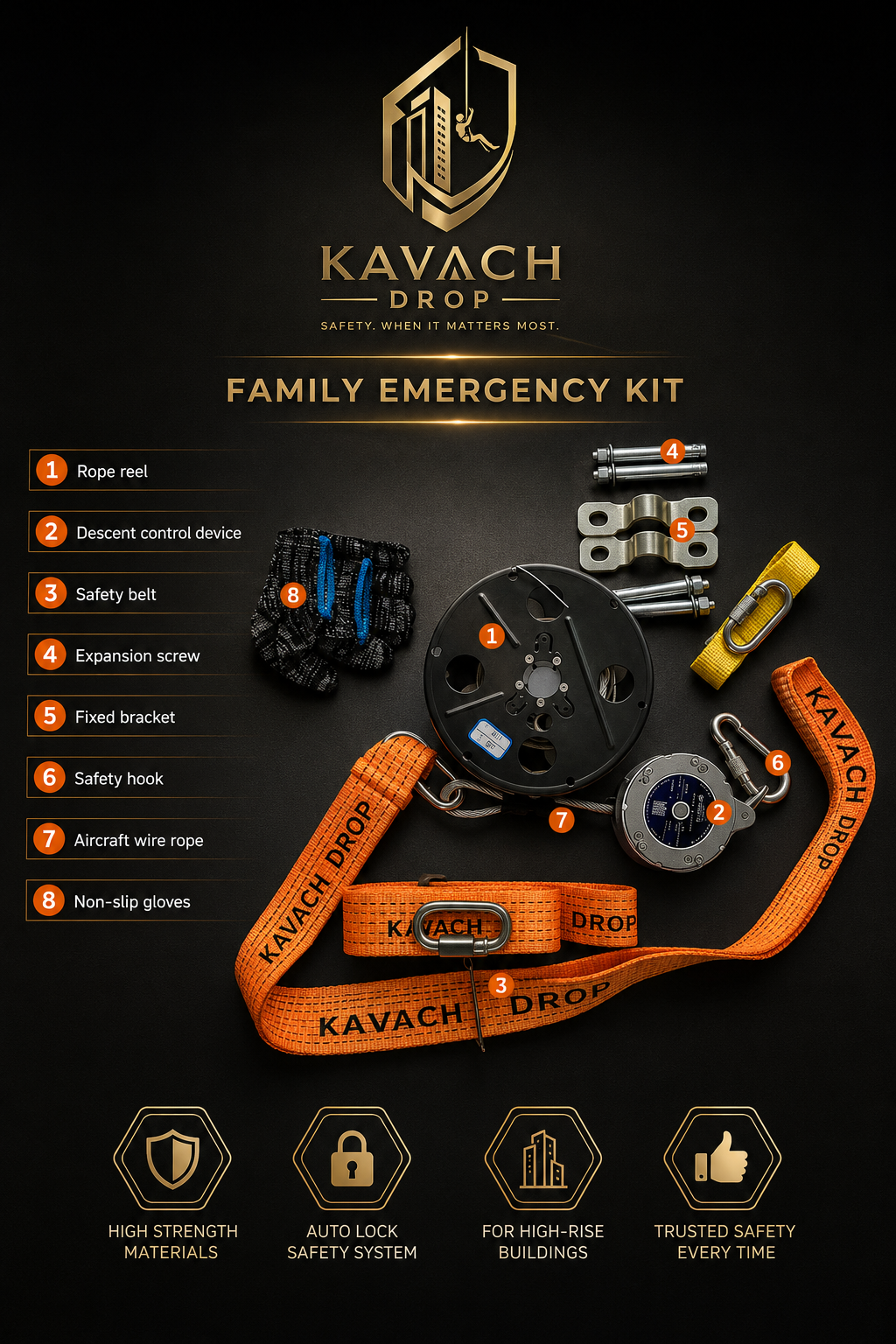
Home fire safety, engineered part by part. Four components, built to work on the worst day you will ever have in your kitchen.
KAVACHDRPTM
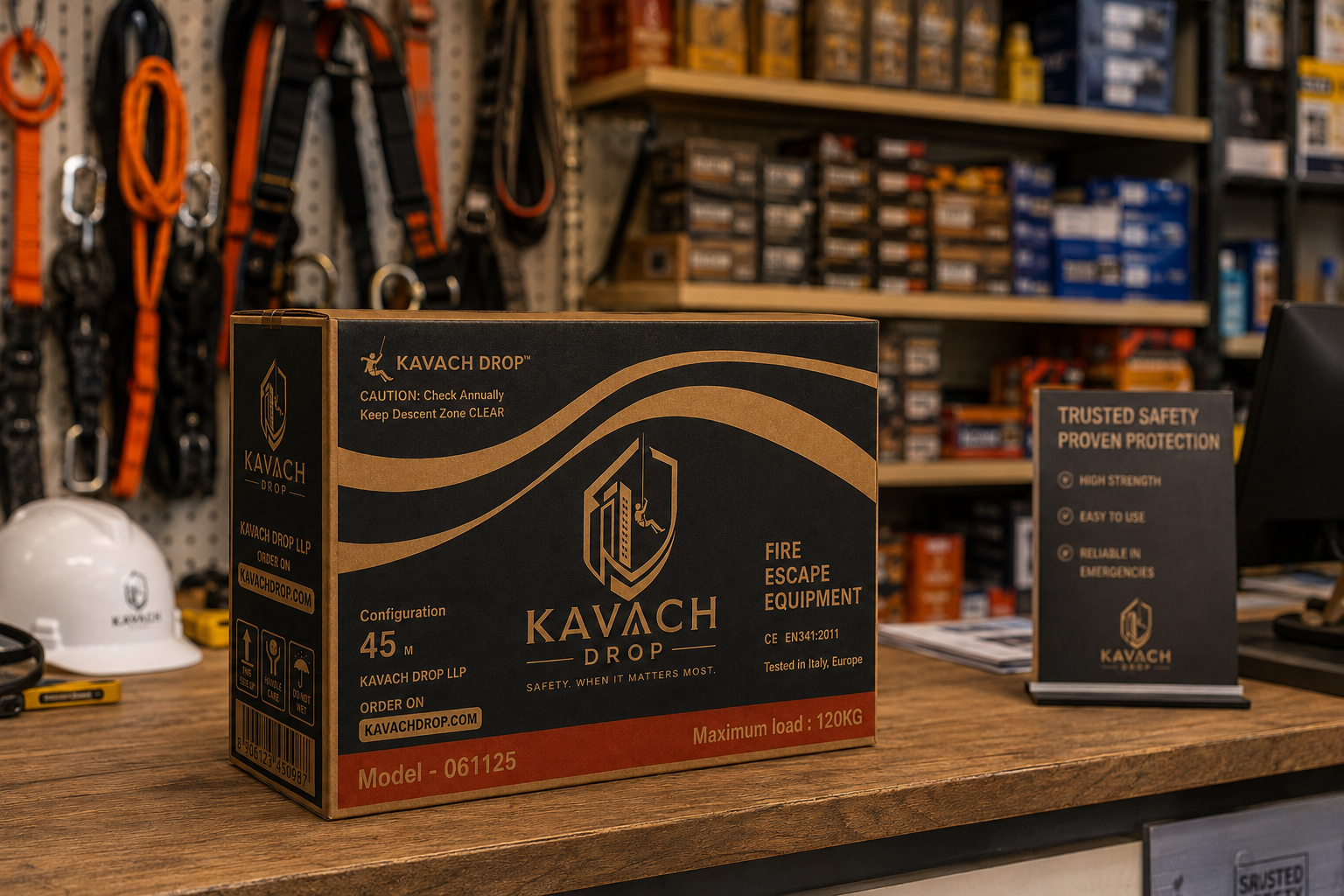
Four parts. One box. Ready the day it arrives.
KAVACH.
Every home already has a plan.
Most of them are hope.
Home fire safety, engineered part by part. Four components, built to work on the worst day you will ever have in your kitchen.
Four parts. One box. Ready the day it arrives.
Kavach Drop mounts at a window, balcony or parapet and lowers one person at a time to the ground. No power. No training. No waiting for a ladder that may not reach your floor.
Four incidents from the last eighteen months. Open any one to see what was blocked, and what was left.
Four fires. 61 people. Every one of them above the fire, with the stair gone.
Talk to us about your buildingKavach Drop does not fight the fire. It makes the window a second staircase.
Incident details as reported by national news agencies and state fire services. Every figure on this page is footnoted to its original source on our references page.
In each of these fires, the people who died were above the fire, on the second floor or higher, with the staircase cut off and a window within reach. That is exactly the situation Kavach Drop exists for.
Oldest on the left, newest on the right. Point at a fire, tap it, or use the arrow keys.
Selected from published news and fire-service reports, September 2023 to August 2026. Fires in hospitals, basements, ground-floor venues or collapsed buildings are left out because a descent device could not have reached those victims. This chart shows where people died in the situation Kavach Drop is designed for; it does not claim that each of them would have lived. Where reports disagreed on a toll, the lowest confirmed figure is used.
| Date | Where | Who was trapped | Lives lost | Source |
|---|---|---|---|---|
| 6 Oct 2023 | Mumbai Goregaon, Jay Bhavani building (G+7) | Homes on the floors above a ground-floor fire | 7 | Report |
| 13 Nov 2023 | Hyderabad Nampally, Bazarghat (stilt + 4) | Families on the 2nd and 3rd floors | 10 | Report |
| 29 Apr 2025 | Kolkata Burrabazar, Rituraj Hotel (six storeys) | Guests on the floors above a 1st-floor fire | 14 | Report |
| 4 May 2025 | Kanpur Chaman Ganj, five-storey building | A family on the 4th floor | 5 | Report |
| 18 May 2025 | Hyderabad Gulzar Houz (G+2) | A family on the floors above a ground-floor fire | 17 | Report |
| 10 Jun 2025 | Delhi Dwarka, Shabd Apartment | A family on the 8th and 9th floors | 3 | Report |
| 21 Oct 2025 | Navi Mumbai Vashi, Raheja Residency | Flats on the 10th to 12th floors | 4 | Report |
| 18 Mar 2026 | Delhi Palam, stock below, homes above | Homes on the 2nd and 3rd floors | 7 | Report |
| 3 May 2026 | Delhi Vivek Vihar, four-storey residence | Homes on the upper floors, one stair, terrace locked | 9 | Report |
| 3 Jun 2026 | Delhi Malviya Nagar, guest house | Guests on the upper floors of a five-storey building | 21 | Report |
| 22 Jun 2026 | Lucknow Aliganj, study centre and studio | A study centre and studio on the upper floors | 14 | Report |
| 19 Aug 2026 | Kolkata Hotel building | Guests stranded on the upper floors | 9 | Report |
Under NBC 2016 Part 4, a refuge area is a holding zone — you assemble there and wait for the fire service or for the smoke to clear. It is not an escape route. The whole strategy assumes a ladder arrives and reaches. Set your floor and see.
At this height, external rescue is not available to you. Your options are the stair, the refuge area, or a way down that does not depend on anyone arriving.
Filmed in a single take from a real balcony at XX.XX m. Nothing cut, nothing sped up, no fire staged for the camera.
Mounted at the window at XX.XX m from the floor. One latch. No tools, no key, no code.
Over the shoulders, one buckle at the chest. It fits over clothing, and adjusts down to a child of XX.XX kg.
Descent speed is governed mechanically at XX.XX m/s. You do not steer it, brake it or hold anything. It lowers you and stops at the ground.
The next person goes as soon as the harness is clear. XX.XX consecutive descents before the unit is spent.
On the 2nd floor a fire on the ground floor puts the stair out of use just as completely as it does on the 30th. Below is where a second route earns its place.
Mixed-use buildings put the fire load directly under the bedrooms, with one stair between them. This is where most Indian fire deaths happen.
High enough that jumping kills, low enough that the building was never given a second stair or a refuge floor.
Code-compliant on paper. In practice, above the reach of most aerial platforms in the country.
No platform in India reaches past roughly 30 floors. Everything above that line is a defend-in-place plan and nothing else.
Every escape product has limits. Most brands hide them. Knowing ours is what makes the rest of this page worth believing.
This is an escape device, not a suppression device. If a fire is small and contained, use an extinguisher and leave the room.
One person at a time, XX.XX descents per unit. A full floor needs a chute or a stair, and your building needs those regardless.
Rated XX.XX–XX.XX kg. Anyone who cannot stand, cannot be supported upright, or cannot get through a window opening will need assisted evacuation. Tell your residents this before you buy, not after.
For offices, hotels, schools and towers it supplements what NBC 2016 Part 4 requires. It does not replace sprinklers, detection, pressurised stairs or refuge areas, and no fire officer will treat it as a credit against them.
Installation and annual inspection are done by a certified installer. A device nobody has checked in four years is not a plan, it is a decoration.
The stairs come first. If the stair is clear, take the stair, and take everyone with you. Kavach Drop exists for the case where it is not clear — and it is never a reason to stay in the building longer.
We do not sell this from a photograph. Every city below has a partner holding a live unit, a trained installer and an appointment slot. Pick yours.
Your city not listed? Tell us where you are and we will bring a unit to you.
Kavach Drop is specified as supplementary egress for the floors above your city's aerial platform reach. We survey the building, identify mounting points, install, train your residents or staff, and inspect annually under contract.
No cost, no obligation. We bring a unit and demonstrate on your own building before you commit to anything.
Kavach Drop cannot be sold from a catalogue. It needs someone who can stand on a roof with a society secretary, survey a mounting point, install it, and come back next year to inspect it. That has to be local. That is the entire reason this network exists.
The first sale is the unit. The business is the annual inspection contract on every unit you have already installed, compounding year on year. Ask us for the model and we will walk you through the arithmetic on real numbers from live territories, not projections.
We publish no income claims. Anyone who can fund a territory can do the arithmetic themselves, and we would rather you did.
Nothing changes. The descent speed is set mechanically and you have no control over it, which is deliberate — there is no brake to grab, no rope to hold, and no way to stop yourself in mid-air. You are lowered whether you are calm or not. That is the single most important design decision in the product.
The harness adjusts down to XX.XX kg, so physically yes, above that weight. Whether a child should go alone is a judgement for the adult present. Where an adult can descend first and receive the child at the bottom, that is the better sequence, and it is what we teach in the demonstration session.
Not necessarily, but it changes the installation. We look for one opening per flat that can be made usable in an emergency — commonly a balcony, a utility window, or a grill panel refitted with a quick-release. If nothing on your floor can be opened, we will tell you that during the survey rather than sell you a unit you cannot use.
The unit is rated to XX.XX m of descent, which covers up to roughly the 30th floor at normal Indian storey heights. Above that we supply a longer-line variant on survey. Below the 2nd floor there is no point — you should be using the stair or the window directly.
The anchor is rated to XX.XX kN and fixes into structural concrete or a reinforced parapet, never into brick infill or cladding. Because it usually touches common property, most societies need a committee resolution first. We provide the structural assessment and the drawing pack you will need to put it to the committee.
They go one after the other, and the second person can start as soon as the harness is back. For a family, that is workable. For a floor of an office or a hotel, it is not, which is why institutional installations are specified per unit per flat or per XX.XX occupants rather than one per building.
A certified installer from your city partner does both. Installation is a same-day job. Inspection is annual, logged, and documented for your fire audit file. Self-installation voids the warranty and, more to the point, we have no way of knowing what you bolted it to.
No. NBC 2016 Part 4 does not list controlled-descent devices among the systems required for a high-rise NOC, and no fire officer will treat it as a credit against sprinklers, detection, pressurised stairs or refuge areas. It is supplementary egress. Anyone who tells you otherwise is selling you a compliance story that will not survive an audit.
The annual inspection, at ₹XX.XX per unit. There is nothing to charge, refill or replace between inspections unless the unit has been used, in which case it is recertified or replaced depending on the descent count on the counter.
Yes, and we would prefer it. Every partner city holds a live unit, and for buildings we bring the unit to you and demonstrate on your own balcony at no cost. If your city is not on the map yet, tell us and we will arrange it.